 Meer documenten
Commission issues €8 billion in its sixth syndicated transaction of 2026
The European Commission has raised €8 billion of EU-Bonds in its 6th syndicated transaction for 2026.
The dual-tranche transaction concerned a €3 billion tap 5-year EU-Bond, maturing on 14 October 2030 and a €5 billion tap of the 15-year EU-Bond, maturing on 12 December 2040.
Building on the pricing of the syndications over the previous three months, the 15-year tap was priced against a reference EU-Bond, and the 5-year EU-Bond was priced against the swap. The approach reflects the growing liquidity of the EU-Bond curve, which can be used as a reliable reference point for pricing of syndicated issuances when deemed desirable.
The transaction is part of the Commission's €100 billion funding target for the first half of 2026 (with €91.8 billion issued since January 2026). The next transaction in the EU's indicative issuance calendar is an EU-Bill auction on 17 June 2026. In line with the EU funding plan, the Commission will finalise its EU-Bond issuances for this semester with an up to €7 billion auction on 22 June 2026 and a related subsequent non-competitive offer. The Commission's funding plan for the second half of the year will be published, as per standard practice, before end of June 2026.
These funds will be used to support the European Union's political priorities, including support for a stronger, more competitive and resilient Europe, support to Ukraine and crucial investments in European defence.
The EU's total outstanding debt now stands at about €825.8 billion, of which €39.9 billion in the form of EU-Bills and €82.7 billion in the form of NextGenerationEU Green Bonds.
EU-Bond transactions (syndications and auctions) executed to date in the first half of 2026 [EUR billion]

|
Background
The Commission is empowered by the EU Treaties to borrow from the international capital markets on behalf of the European Union to finance selected EU policy programmes. This includes the NextGenerationEU recovery instrument, financial support programmes to Ukraine and other neighbourhood countries as well as the EU's Security Action for Europe – SAFE – instrument, helping EU Member States carry out urgent defence investments through common procurement.
Use of proceeds from EU borrowing operations under different programmes [EUR billion]
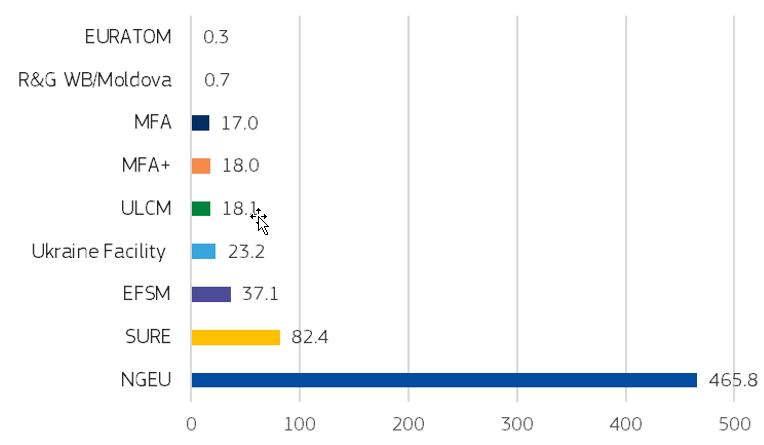
EUR outstanding amounts per programme, as of 29 May 2026.
Disclaimer: under the Commission's unified funding approach outstanding disbursements may be different to the amount of outstanding EU-Bonds at a specific point of time)
The Commission uses EU-Bonds and EU-Bills as the main funding instruments to raise funds on capital markets. All issuances executed by the Commission are denominated exclusively in euro. Since January 2023, the EU funds its different policy programmes by issuing single-branded EU-Bonds rather than bonds for individual programmes. The Commission also issues green bonds (under the NextGenerationEU Green Bond label), to finance the green component of the Recovery and Resilience Facility of the NextGenerationEU programme.
The European Commission raises funds using both auctions and syndicated transactions as part of its funding strategy. Auctions allocate EU-Bills and EU-Bonds through a competitive bidding process among Primary Dealers, ensuring transparency and cost efficiency. In contrast, syndicated transactions involve a group of Primary Dealers placing bonds directly with investors, allowing for broader investor reach and optimized execution, particularly for large or inaugural deals. The two methods are used in a complementary way to support market access and funding flexibility.
EU borrowing is guaranteed by the EU budget, with contributions to the EU budget an unconditional legal obligation of all Member States under the EU Treaties.
For regular updates on the EU's borrowing and lending activities you can subscribe here to the quarterly investor newsletter.
For more information
H1 Funding Plan Update - Commission to issue €100 billion in EU-Bonds in the first half of 2026
Factsheet on Budgetary safeguards protecting investor in EU-Bonds and EU-Bills
